Photographs don’t just capture faces—they document diplomacy, thaw tensions, and freeze moments of cultural exchange in time. When a British monarch steps onto American soil, the images that follow are never just about pageantry. They’re political signals, exercises in soft power, and, often, deeply human encounters between two nations bound by history, language, and occasional friction.
As King Charles III embarks on a state visit to the United States—his first as sovereign—the spotlight turns once again to how royal presence is framed through photography. From Edward VIII’s pre-coronation tour to Queen Elizabeth II’s record-setting trips, each image tells a story not just of who was there, but of what the moment meant.
These photos, preserved in archives and re-shared across generations, reveal how royal visits have evolved—and how visual storytelling shapes public perception of monarchy in a republic.
The Photographic Power of Royal Diplomacy
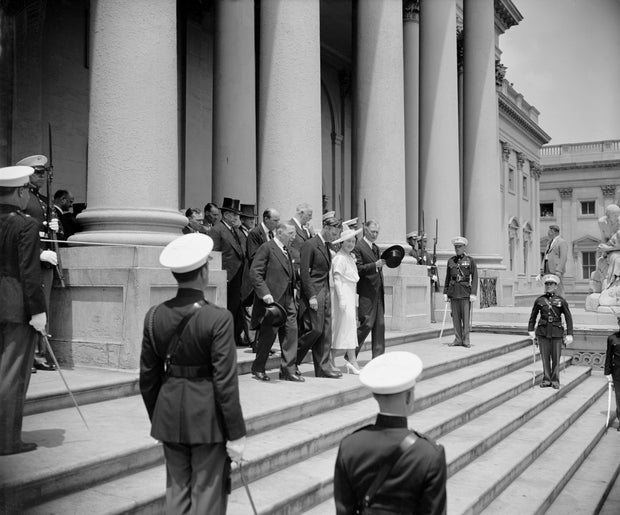
Royal visits to the U.S. are rare. Since 1939, only four reigning or future British monarchs have made official trips: Edward VIII (as Prince of Wales), George VI, Queen Elizabeth II, and now King Charles III.
Each visit has been meticulously documented. But it’s not just about recording events—it’s about curating image. In an age before live streaming and social media, photographs were the primary way the public experienced royal travel. A single frame could soften centuries of post-colonial tension or spark headlines on both sides of the Atlantic.
Examples:
- 1939: King George VI at a barbecue in Hyde Park, New York – The image of a British king eating pulled pork, wearing a slightly ill-fitting suit, humanized the monarchy during a time of looming war.
- 1957: Queen Elizabeth II addressing Congress – The photo of the young queen standing before the U.S. legislature, composed and regal, signaled Britain’s enduring global relevance.
- 2023: King Charles III laying a wreath at the 9/11 Memorial – A solemn, tightly framed shot conveying respect, solidarity, and shared grief.
These aren’t just memories. They’re strategic visual statements, carefully composed by court photographers and White House press teams alike.
Edward VIII: The First Royal Footsteps (Pre-Coronation)
Long before he abdicated the throne for Wallis Simpson, Edward—then Prince of Wales—was Britain’s most glamorous royal export. In 1924, he toured the U.S., becoming the first senior royal to do so.
Photographs from that trip show a dashing, smiling figure shaking hands in New York, touring coal mines in Pennsylvania, and even operating a locomotive in West Virginia. The images were widely circulated in American newspapers, often under headlines like “The Prince Who Likes Jazz.”
But behind the charm offensive, there was intent: to rebuild British prestige after World War I and strengthen economic ties. The photos succeeded—Edward was a hit. But they also foreshadowed a problem: a royal who mingled too freely with the public risked appearing more celebrity than sovereign.
A 1924 photo of Edward lighting a cigarette at a press conference—unprompted, mid-sentence—raised eyebrows in London. It was modern, relatable, and, to some, undignified. The tension between relatability and reverence, visible even then, would echo through future visits.
George VI: Wartime Unity in a Single Frame
:max_bytes(150000):strip_icc():focal(728x275:730x277)/princess-catherine-prince-william-donald-trump-king-charles-iii-trump-state-visit-uk-windsor-091725-8672599a27214b6f8ffdbb07fd7596e4.jpg)
The most historically significant royal visit came in 1939, when King George VI and Queen Elizabeth (later the Queen Mother) toured North America. Their U.S. stop was brief—just two days—but its impact was enormous.
One photograph defines the trip: the royal couple seated at a picnic table with President Franklin D. Roosevelt at his family home in Hyde Park. The king, sleeves rolled up, eats a hot dog. Queen Elizabeth sips coffee from a paper cup. No silver service. No formal dining room.
The image was revolutionary. Here was the British king—the symbolic head of an empire—participating in a quintessentially American ritual. The photo ran in newspapers across the country, often with the caption: “The King Eats a Hot Dog.”
It wasn’t happenstance. Roosevelt orchestrated the informal setting to make the king appear approachable, to break down class barriers, and to subtly signal that Britain, despite its monarchy, could be a democratic ally. At a time when U.S. isolationism was strong, the photo helped humanize Britain and build sympathy for its plight as war loomed in Europe.
Queen Elizabeth II: The Reign of Royal Photo Ops
No monarch visited the U.S. more than Queen Elizabeth II. Over seven decades, she made 26 trips, each documented with precision.
Her first state visit in 1957 set the tone. Photos from that trip show her addressing Congress, touring the Grand Canyon, and attending a state dinner at the White House. One iconic image—Elizabeth laughing during a lighthearted exchange with President Eisenhower—became symbolic of Anglo-American warmth.
But it wasn’t all polished moments. In 1976, during the U.S. bicentennial tour, Elizabeth wore a red dress while riding in an open-topped Cadillac through Philadelphia. The photo went viral in the pre-digital sense—reprinted endlessly. Some Americans joked she’d chosen red as a nod to the Revolutionary War, but it was likely coincidence. Still, the image was potent: the monarch of the former colonial power touring the birthplace of American independence, smiling, saluting, and surviving the irony.
Later visits adapted to changing times:
- 1991: During the Gulf War, she visited U.S. troops in Saudi Arabia—photos showed her in a desert camouflage coat, visiting mess halls.
- 2007: At the Jamestown anniversary, she toured a replica colonial settlement. A photo of her peering into a thatched-roof hut, expression mildly bemused, captured the oddity of a British queen observing the roots of a rebellion against her ancestors.
Through it all, Elizabeth mastered the visual language of diplomacy: consistent, contained, but never cold. Her photos rarely showed strain, even during politically delicate moments.
Prince Charles Before the Crown: A Different Kind of Royal Image
Long before becoming king, Charles visited the U.S. frequently—often promoting environmental causes or opening British cultural exhibitions.
His 1993 trip included a controversial photo: him standing beside Vice President Al Gore, announcing a joint climate initiative. At the time, the image was seen as forward-thinking. In hindsight, it highlights how Charles used unofficial visits to shape his legacy—one focused on activism, not just ceremony.
Other telling images:
- 1985: Charles dancing with Diana at a White House gala, photographed mid-laugh. The moment radiated glamour but, viewed today, carries melancholy, foreshadowing their later collapse.
- 2011: Opening the National Museum of African American History and Culture’s early exhibit. He listened intently as a guide explained slavery’s legacy—a rare image of a royal engaging directly with America’s painful history.
:max_bytes(150000):strip_icc():focal(749x0:751x2)/king-charles-III-state-visit-of-the-president-of-the-republic-of-south-africa-112222-4-806910a78d3444cf87ef8dcb828390e0.jpg)
These photos helped define Charles as more introspective, more modern—yet always constrained by protocol. His expressions were often studied, less spontaneous than his mother’s. The camera caught the weight of expectation.
King Charles III: A State Visit in a Polarized Age
Charles’s first U.S. state visit as king arrives at a complicated moment. America is politically fractured. The monarchy, post-Harry and Meghan, faces skepticism. Climate change, social justice, and democratic resilience are central themes.
Photos from this visit will be scrutinized not just for optics, but for subtext.
Early images from the 2023 trip reveal a shift in tone:
- Wreath-laying at the 9/11 Memorial: Close-up shots emphasize stillness, respect. Charles’s expression is somber, hand over heart. The photo avoids grandeur—it’s about shared trauma.
- Meeting with President Biden at Camp David: A relaxed shot of the two leaders walking through the woods, mid-conversation. No ties, no formal gardens. It suggests informality, continuity.
- Addressing climate youth activists in Boston: Wide-angle photo showing Charles listening, hands clasped. The composition places him among American youth, not above them.
These images reflect a deliberate effort: to present Charles not as a distant sovereign, but as a concerned global citizen. The visual narrative is softer, more urgent, less about crown and more about cause.
But challenges remain. Unlike his mother, Charles never had the blank-slate appeal of youth. Americans know his story—the divorces, the controversial memos, the heir apparent with strong opinions. Photos can’t erase that. They can only reframe.
How Royal Photos Shape Public Perception
It’s easy to dismiss royal imagery as PR. But in transatlantic relations, photographs do real diplomatic work.
Consider:
- A 1976 photo of Elizabeth saluting the Stars and Stripes was displayed in U.S. schools for years.
- The 1939 hot dog image is still used in history textbooks to illustrate pre-WWII alliances.
- Charles’s 2023 climate event photo was shared by environmental NGOs to lend credibility to their campaigns.
These images endure because they simplify complex relationships into single, emotional moments.
Yet, missteps happen:
- In 2008, a photo of Prince William in a Nazi uniform—taken at a costume party—resurfaced during a U.S. trip, derailing positive coverage.
- A 2010 shot of Prince Philip squinting at a wheelchair-bound child was widely misinterpreted as disdain (he later clarified he was adjusting his glasses).
The lesson? In the visual age, one frame can overshadow an entire itinerary.
What the Future Holds: Monarchy in the Lens
King Charles III’s state visit is likely the last of its kind for a generation. Prince William may visit as prince or king, but the context will be different—more digital, more decentralized.
Future royal photos may come less from official pools and more from TikTok, Instagram, or protest signs. The image of monarchy will be harder to control.
But the core purpose remains: to bridge nations through human moments.
As Charles walks through Washington, attends dinners, lays wreaths, and shakes hands, photographers will chase the “money shot”—that one image that captures the visit’s essence.
It might be him pausing to speak with a veteran. Or embracing a survivor of gun violence. Or standing silently beneath a maple tree at Arlington.
Whatever it is, that photo will outlive the trip. It will be printed, shared, archived. And decades from now, someone will point to it and say: “That’s when the king came to America.”
Just like before.
FAQ
What should you look for in Royal Moments: British Monarchs in America Through Photos? Focus on relevance, practical value, and how well the solution matches real user intent.
Is Royal Moments: British Monarchs in America Through Photos suitable for beginners? That depends on the workflow, but a clear step-by-step approach usually makes it easier to start.
How do you compare options around Royal Moments: British Monarchs in America Through Photos? Compare features, trust signals, limitations, pricing, and ease of implementation.
What mistakes should you avoid? Avoid generic choices, weak validation, and decisions based only on marketing claims.
What is the next best step? Shortlist the most relevant options, validate them quickly, and refine from real-world results.